Showing all 21 games, including Bogey Tax & Poor Putting Punisher under Junk Bets
9 Point
Exactly 3 Players
Classic 3-player game. 9 points per hole split by net score ranking: 1st gets 5, 2nd gets 3, 3rd gets 1. Ties share points.
The definitive three-player Golf Game. Exactly 9 points are split each hole based on net score ranking — 1st place gets 5, 2nd gets 3, 3rd gets 1. When two players tie, they split the combined points equally. Ties for all three give everyone 3 points. The player who racks up the most cumulative points across the full round wins the pot. Simple to track, endlessly competitive.
16 Point
Exactly 4 Players
9 Point for a foursome. 16 points per hole split by net score ranking: 7, 5, 3 and 1. Ties share points.
Everything that makes 9 Point great, built for four. Exactly 16 points are split each hole based on net score ranking — 1st place gets 7, 2nd gets 5, 3rd gets 3, 4th gets 1. Tied players split the points for the places they occupy, so two players tied for low get 6 each, and if all four tie everyone gets 4. Play for the pot, where the most cumulative points across the full round wins, or per point, where players settle up on the difference in their points.
Best Ball
Exactly 4 Players (2v2)
2-vs-2 game. Each player plays their own ball. On every hole the team takes the better (lower) score of its two players.
Each player plays their own ball throughout the round. After each hole, the team's score is the lowest score between the two teammates. In net Best Ball, handicap strokes are applied based on each golfer's index. Best Ball offers a blend of competition and fun. If someone has a bad hole, their teammate can still ensure the team has a strong score for that hole.
Bingo Bango Bongo
2–4 Players
Earn points for first on the green, closest to the pin, and first in the hole.
Three mini-competitions every single hole, making even bad ball-strikers competitive. Bingo: first player to reach the green earns a point. Bango: player closest to the pin once everyone is on the green earns a point. Bongo: first player to hole out earns a point. Critically, play must happen in strict handicap order — no skipping ahead. High-handicappers actually have an advantage here, making it a great equalizer.
Defender
Exactly 3 Players
One player defends each hole solo against the rest of the group. The role rotates every hole.
A thrilling head-to-head format perfect for threesomes. One player is designated the Defender each hole and plays solo against each of the other two. Beat an opponent's net score and the Defender earns a point; lose to an opponent and that opponent earns the point. A tie earns nothing, so two points are up for grabs on every hole. At the end, the most points takes the pot, or settle up on the difference in points. The Defender role rotates every hole so the pressure lands on each player equally. Simple stakes can create massive swings.
Low Ball / High Total
Exactly 4 Players (2v2)
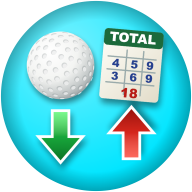
2-vs-2 team game. Win 1 point for the best individual score (Low Ball) and 1 for the team whose worst player still beat the other team's worst (High Total).
A tricky 2-vs-2 format where both players really have to show up. Low Ball rewards the team with the best individual net score on the hole. High Total (also called "Low High") rewards the team whose worst player had the better (lower) net score — so there's no hiding behind your partner. A team that sweeps both points had both players outperform their opponents. Pressure comes from every player every hole.
Low Ball / Low Total
Exactly 4 Players (2v2)
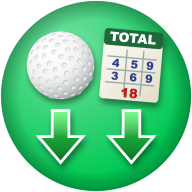
2-vs-2 team game. Win 1 point for the best individual score (Low Ball) and 1 for the lowest combined team score (Low Total) each hole.
A classic 2-vs-2 team format with two points on the line every hole. Low Ball goes to the team with the best individual net score on the hole. Low Total goes to the team with the lowest combined (summed) net score. Teams can split the points, sweep both, or walk away with nothing when it ties. Two bets every hole keeps the pressure on from the first tee to the last green.
Low / High / Total
Exactly 4 Players (2v2)
A 2-vs-2 team game. 1 point for the best individual score (Low Ball), 1 point for the best team total, and 1 point for the team whose worst player beats the other team's worst (High Ball). 3 points available per hole.
The most complete 2-vs-2 team format — three points on the line every hole. Low Ball rewards the team with the best individual net score. Team Total rewards the team with the lowest combined (summed) net score. High Ball rewards the team whose worst player still beat the other team's worst player — so there's no hiding behind a strong partner. Sweeping all three points takes a genuinely dominant hole from both players.
Match Play
2–4 Players
Head-to-head, hole by hole. Whoever wins the most holes takes the match.
The purest form of golf competition — Ryder Cup style. Every player goes head-to-head against every other player on each hole using net scores. Win a hole and earn a point; tie it and nobody scores. Stroke totals are irrelevant — it's all about hole-by-hole bragging rights. The player who wins the most head-to-head points across the full round takes the pot. Great for when stroke play feels too punishing.
Medal Play
2–4 Players
Medal Play (Stroke Play). The player with the lowest score at the end of the round wins.
The oldest and simplest format in golf, and the one every other game is built on. Total up every stroke across the whole round — the player with the lowest total score wins. No holes to track individually, no partners, no rotating roles. Works cleanly with 2, 3, or 4 players, and plays exactly the way handicaps are set up for the round: net scores when handicaps are on, gross scores when they're off.
Nassau
2–4 Players
Three bets in one round: front 9, back 9, and overall 18-hole total.
The most popular Golf Game in the world. Nassau creates three separate bets inside a single round — Front 9, Back 9, and Overall 18. You set a stake for each segment, and the lowest net score in each one wins. Play as Stroke Play (lowest total) or Match Play (most holes won). Tie the Front 9 or Back 9 and its bet can carry into the Overall.
Quota
2–4 Players
Race your personal target. Points on gross score — birdie = 4, par = 2, bogey = 1. Beat your quota (36 − handicap) by the most to win.
An individual points game where everyone competes against their own handicap-adjusted target rather than each other. Your quota is 36 minus your Course Handicap. Points are earned on gross score each hole — Bogey = 1, Par = 2, Birdie = 4, Eagle = 8. Beat your quota by the most points to win. It's a great leveler, since a scratch player and a 20-handicapper are both aiming to outperform their own target.
Rockaway Wolf
Exactly 3 Players
Fast-paced Wolf played for high stakes on every hole.
A fast-paced, per-hole, high-stakes game. Every hole settles on its own, so there is something on the line on every shot. Every hole is worth the hole value, the stake your group agrees on before the round. The Wolf rotates each hole, and each player is the Wolf 6 times. After the tee shots, the Wolf picks a partner and plays against the third player, or goes Lone Wolf against both. When the Wolf and partner win, they each win the hole value. A Lone Wolf win pays 2× the hole value, collected from the other players. If the Wolf’s side loses, the other side wins the same way. If the single player beats the Wolf and partner, they win the hole value, paid half each by the Wolf and partner. Win the hole with a birdie and the payout doubles; win it with an eagle and it pays 4×.
How it’s scored
Wolf’s call
Par or worse
Birdie
Eagle
Wolf + partner
1×Each winner
2×Each winner
4×Each winner
Lone Wolf
2×Wolf total
4×Wolf total
8×Wolf total
Payouts are multiples of the hole value. Birdies and eagles count on the winning score. Tied holes: no payout.
Rockaway Wolf (4 Player)
Exactly 4 Players
Fast-paced Wolf played for high stakes on every hole.
A fast-paced, per-hole, high-stakes game. Every hole settles on its own, so there is something on the line on every shot. Every hole is worth the hole value, the stake your group agrees on before the round. The Wolf rotates through holes 1–16. After the tee shots, the Wolf picks a partner (2 vs 2) or goes Lone Wolf against all three. When the Wolf and partner win, they each win the hole value. A Lone Wolf win pays 3× the hole value, collected from the other players. If the Wolf’s side loses, the other side wins the same way. Win the hole with a birdie and the payout doubles; win it with an eagle and it pays 4×. Holes 17 & 18: before the round, choose no multiplier, 2× or 3×, with birdies and eagles multiplying on top. The rotation stops and the player furthest behind is the Wolf. The same player can be the Wolf on both if they are still furthest behind after 17.
How it’s scored
Wolf’s call
Par or worse
Birdie
Eagle
Wolf + partner
1×Each winner
2×Each winner
4×Each winner
Lone Wolf
3×Wolf total
6×Wolf total
12×Wolf total
Payouts are multiples of the hole value. Birdies and eagles count on the winning score. Tied holes: no payout.
Six-Six-Six
Exactly 4 Players
A best ball team game. Partners rotate every six holes so everyone teams up with each other once.
A rotating best ball game that keeps all four players invested across the entire round. Split into two teams of two for each six-hole segment, and teams rotate so everyone partners with everyone else exactly once. On every hole, the lowest individual score on each team is the team's score. Scores are not added together. The team with that lowest single score wins the hole, and the team that wins more holes wins the six. Each six (First 6, Second 6, Third 6) is its own bet with its own stake, and the live scorecard tracks them as F6 / S6 / T6.
Skins
2–4 Players
Win a hole outright to claim the skin. Ties carry the value over to the next hole.
The original per-hole Golf Game — simple, exciting, and works with any group. Each hole is its own bet. Win a hole outright with the lowest net score and you claim that skin. If two or more players tie, no skin is awarded and its value rolls over to the next hole, building up the pot. Those carried-over holes can get nerve-wracking fast. The pot is divided equally across the holes, so each skin pays the winner that hole's share plus anything carried over. Holes nobody wins pay nothing. You can also turn carryovers off.
Snake
2–4 Players
Whoever three-putts (or worse) last is stuck holding the snake — and pays up at the end.
The putting pressure game that makes two-putting feel like a life-or-death situation. The snake is a penalty — whoever three-putts most recently is stuck holding it. Once you pick it up, you hold it until another player three-putts — then it passes to them. Whoever is holding the snake at the end of the round pays the snake's value, split evenly among the other players. Example: a $30 snake with 4 players means the holder pays $10 to each of the other 3. If no one is holding the snake at the end, no one pays. The value stays the same all round unless you turn on the Snake Multiplier, which raises it each time the snake moves to another player. Perfect as a side game alongside any other format.
Stableford
2–4 Players
Points are awarded based on your score relative to par — highest total points wins.
A points game loved by club golfers everywhere. Instead of counting every stroke, you earn points on each hole based on your net score relative to par: Bogey = 1, Par = 2, Birdie = 3, Eagle = 4, Albatross = 5. A double bogey or worse scores zero — pick up the ball and move on. The player with the most points at the end wins, or play for a value per point and settle up on the difference in points. It keeps play moving, and one blow-up hole can't ruin your round.
Vegas
Exactly 4 Players (2v2)
Partner scores combine into a two-digit number — a low score "flips" the opponents' total.
A wild partner game that lives up to its name. Teams of two combine their net scores into a two-digit number each hole — the lower score goes in the tens place, higher in the units (e.g. scores of 4 & 6 → 46). A birdie or better lets your team "flip" the opponents' number (46 becomes 64). The team with the smaller number wins the difference in points. A single flip can swing the entire match.
Wolf
Exactly 3 Players
Each hole a rotating "Wolf" picks a partner — or goes it alone for double the points.
One of the most strategic and entertaining games in golf. Players rotate as the Wolf each hole. After each tee shot, the Wolf decides whether to pick that player as a partner (best ball vs. the other player) or pass. After all tee shots, if no partner was chosen, the Wolf goes alone. "Lone Wolf" plays solo against the group for 4 Points or "Blind Wolf" plays solo against the group before anyone else tees off for 8 Points. Choosing wisely — or bravely — is everything.
How it’s scored
Wolf’s call
Wolf side wins
Wolf side loses
Partner
2Wolf & partner each
3Other player
Lone Wolf
4Wolf
2Each opponent
Blind Wolf
8Wolf
4Each opponent
The losing side scores 0. Tied holes score nothing.
Wolf (4 Player)
Exactly 4 Players
Four-player Wolf — a rotating Wolf picks a partner, or takes on all three alone.
Wolf for a full four-ball. Players rotate as the Wolf each hole. After each tee shot, the Wolf decides whether to pick that player as a partner (best ball vs. the other two) or pass. After all tee shots, if no partner was chosen, the Wolf goes alone. "Lone Wolf" plays solo against the group for 6 Points or "Blind Wolf" plays solo against the group before anyone else tees off for 12 Points. Choosing wisely — or bravely — is everything.
How it’s scored
Wolf’s call
Wolf side wins
Wolf side loses
Partner
2Wolf & partner each
2Each opponent
Lone Wolf
6Wolf
2Each opponent
Blind Wolf
12Wolf
4Each opponent
The losing side scores 0. Tied holes score nothing.
No games match that search. Try another name or filter.
Side bets
Junk Bets
Stack optional side bets worth "dots" alongside any of the games above, all settled in dots.
Bogey Tax & the Poor Putting Punisher are on the Junk Bets page too. Each has its own pot, and they don't count toward your 4 selected games.
1 dot
Birdies
One dot for every birdie or better.
3 dots
Eagles
Eagles are worth 3 dots — a big swing for a great hole.
1 dot
Chip Ins
One dot for holing out from off the green.
1 dot
Closest to Pin
On par 3s — closest tee shot wins 1 dot. 3-putt penalty: lose your dot and others each gain 1.
3 dots
Hole Out 50+
Three dots for holing out from over 50 yards away.
1 dot
Par Saves
One dot for saving par after taking a penalty stroke. No dots lost for bogey or worse.
3 dots
Sand Save · Hole Out
Hole out directly from the bunker (any score).
1 dot
Sand Save · Saving Par
Get up and down from a bunker to make par.
Bogey Tax
2–4 Players
Every bogey, double, and triple-or-worse pays a tax into the pot. Lowest score at the end takes it all.
Every mistake costs you. This game turns your own scorecard against you: a bogey, a double bogey, or a triple-or-worse each pays its own tax straight into a shared pot, calculated automatically from the strokes you already enter — no extra tracking needed. Here's the twist: it doesn't matter how much you personally paid into the pot. Whoever posts the lowest total score for the round (net if handicaps are on, gross if off) takes the entire pot, tax contributions included. Grind out steady pars while everyone else racks up doubles, and you could walk away funded entirely by their bad holes.
Poor Putting Punisher
Any Group Size
Player with the fewest putts throughout the round wins.
Three-putt at your own risk. This game rewards the steadiest hands on the green and makes everyone else pay for it. Here's the twist: set a price for 3-putts, 4-putts, and 5-putts-or-worse before you tee off. Every time someone blows up on the green, that amount goes straight into the pot. Play it on a course with big, undulating greens and watch the tension build hole by hole — one bad read, one blown lag putt, and you're funding someone else's payday. Nerve-wracking, hilarious, and brutally fair.
Snake Multiplier
Turn it on and the snake's value goes up by its starting value each time it moves to another player. The value is the total the holder pays, split evenly among the other players.
Example: the snake starts at $5
1st player to hold it: $5 split among the others
Moves to a 2nd player: $10 split among the others
Moves to a 3rd player: $15 split among the others
Each move after that adds another $5, even if it goes back to someone who already had it.
Only the player holding the snake at the end of the round pays. Leave the multiplier off and the snake keeps the same value all round.
1 Putt Redemption
One good putt erases the bad. Turn on 1 Putt Redemption and one putt erases your biggest donation to the pot.
1-putts are not banked — a 1-putt only cancels out a previous putting disaster.


 9 Point
 16 Point
 Best Ball
 Bingo Bango Bongo
 Defender
 Low Ball / High Total
 Low Ball / Low Total
 Low / High / Total
 Match Play
 Medal Play
 Nassau
 Quota
 Rockaway Wolf
 Rockaway Wolf (4 Player)
 Six-Six-Six
 Skins
 Snake
 Stableford
 Vegas
 Wolf
 Wolf (4 Player)





 Bogey Tax
 Poor Putting Punisher